Generative engine optimization (GEO): how it works and how to track it
Generative engine optimization is how you get retrieved and cited by ChatGPT, Gemini, and Perplexity. Here is how GEO works, how to monitor what AI says about your brand, and how to measure it.
After years of chasing Google rankings, marketing teams now have a second question to answer: whether ChatGPT, Perplexity, Gemini, and Claude mention the products they are responsible for. When your content gets cited by an AI answer, you gain credibility and visibility with a growing group of searchers. When it does not, you are effectively invisible to them.
This guide covers how generative engine optimization works, what drives AI citations, how to monitor what generative engines say about your brand, and how to measure the whole thing.
What is generative engine optimization (GEO)?
Generative engine optimization (GEO) is the practice of structuring and distributing your content so AI search engines like ChatGPT, Gemini, Perplexity, and Google AI Overviews retrieve and cite it when they build answers. It shapes whether your brand appears in AI responses, and how accurately.
Because the field is still emerging, you will also see the terms AEO (answer engine optimization), LLM SEO, and AI search optimization. They all point to the same idea: making your content discoverable and quotable in AI-generated answers. In practice, GEO is another layer of SEO. Search is no longer limited to Google’s SERPs, which is why the SEO playbook now runs on discoverability rather than rankings.
What are generative search engines?
Generative search engines combine AI language models with web retrieval to answer a question directly, then cite the sources they consider relevant and authoritative. Instead of returning a list of ten blue links, they synthesize the answer into a conversational response.
There are two main entry points to AI search.
Direct AI interaction platforms
Users start their search inside an AI interface and ask questions conversationally through ChatGPT (and its Search feature), Perplexity, Claude, Microsoft Copilot, Gemini, and Google AI Mode.
Traditional search with AI features
Users start on a familiar search engine and receive an AI-generated response:
- Google AI Overviews: AI-generated summaries at the top of Google results. These can occupy up to 75.7% of screen real estate on mobile and 67.1% on desktop.
- Google AI Mode: Google’s conversational AI search experience for complex, multi-step questions with follow-ups. By mid-2026 it had passed a billion monthly users and runs on Gemini 3.5 Flash as its default model globally. It can tailor results to a user’s preferences, plans, and connected apps like Gmail, so two people can ask the same thing and see different answers.
- Bing AI results: Microsoft’s AI-generated answers inside its traditional SERPs.
How does generative engine optimization work?
Generative engine optimization works by influencing the content and signals AI engines rely on: clear, well-structured information, a strong brand presence, and authoritative third-party mentions, so that when an AI assembles an answer, it retrieves and cites you. To optimize for these engines, it helps to understand how they build an answer in the first place.
Here is the process most AI search engines follow:
- The AI analyzes what you are asking, including context from your previous questions, and identifies the key concepts, intent, and requirements in your query.
- It gathers information from several sources, depending on the model: real-time web search, knowledge databases, and sometimes several simultaneous searches for a complex question.
- It evaluates those sources on relevance, authority, information quality, and recency.
- It combines them into a coherent, conversational answer.
Some platforms, like Perplexity and Google AI Overviews, show citations with direct links. Others, like certain ChatGPT and Claude modes, may answer without visible attribution, which means your brand can be featured without any click reaching your site.
Does GEO help your brand appear in ChatGPT and AI Mode?
Yes. GEO is precisely the work that makes an engine like ChatGPT, Google AI Mode, or Perplexity more likely to surface and cite your brand. You do it by publishing content the engine can parse and quote, and by building the third-party mentions and brand authority those engines weigh when they choose sources.
The lever is indirect. You do not submit anything to ChatGPT. You shape the signals it reads across the open web, then check whether the answers move.
GEO vs SEO: are they really different?
SEO optimizes for ranking in traditional search results; GEO optimizes for being retrieved and cited inside AI-generated answers. They overlap, since strong rankings often correlate with AI visibility, but GEO leans harder on brand authority, original research, and clearly structured, quotable content than on keyword targeting and backlinks.
Kevin Indig’s analysis of over 7,000 AI citations found that the top 10% of most-cited pages across AI platforms “have much less traffic, rank for fewer keywords, and get fewer total backlinks” than their SEO counterparts. A page Google has de-indexed can still be retrieved and cited in an AI answer, because engines weigh clarity, structure, and authority differently than a SERP does.
The two still share a foundation. Many LLM-based tools rely heavily on live or indexed web content, and a recent study found a strong correlation between Google rankings and AI visibility: the higher a page ranks within the top 10, the more likely it is to be used in AI answers. Core SEO principles carry over too, especially a strong and trustworthy brand, original high-quality content, and external authority signals.
How do users search in 2026?
Search has become more fragmented, and much of it now ends without a click. A study found that nearly 60% of Google searches end with no click at all, while AI search tools keep gaining ground: 71.5% of US consumers report having used ChatGPT and similar tools to search, though only 14% use them daily.
Most people use AI alongside traditional search rather than in place of it. For shopping inspiration, social search is rising, with 43% of Gen Z consumers starting product searches on TikTok.
The practical takeaway: search visibility now extends well beyond direct search traffic. When your brand appears in AI answers or zero-click results, you build recognition that influences decisions later, even when the user does not click through today.
How to implement generative engine optimization (GEO)
The core principles of GEO mirror long-standing content best practices. As Kevin Indig, Growth Advisor, puts it: “Classic SEO metrics don’t matter nearly as much for AI chatbot mentions and citations. The best thing you can do for content optimization is to aim for depth, comprehensiveness, and readability.” The GEO-specific twists sit on top of that foundation. Here are the steps that matter most.
1. Build brand awareness and authority
The stronger your brand, the higher your chances of being featured, mentioned, and cited. Research analyzing 10,000 LLM queries found that brand search volume had a correlation coefficient of 0.18 with AI mentions, the second strongest signal after domain rank at 0.25.
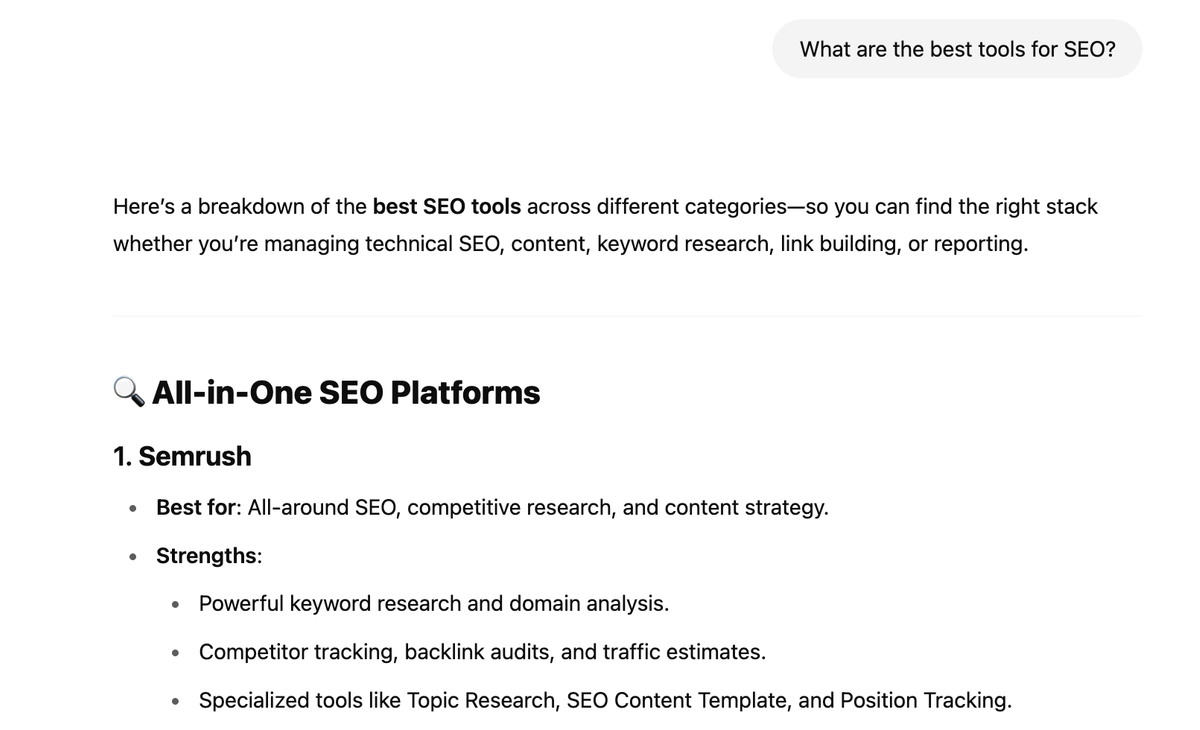
Established brands tend to have a stronger presence on trusted sites, higher domain authority, and more coverage in credible publications, and AI engines read all three. You can observe this directly: ask ChatGPT for the “best running shoes for a first marathon,” and long-established brands like Brooks, Hoka, or ASICS almost always surface first, because years of reviews and coverage across cited publications compound into AI visibility. Here, brand strength is an input the engine reads.
2. Share an original POV and publish research
Publishing original research and a genuine point of view earns external mentions, positions your team as an authority, and gives AI something it cannot synthesize on its own. Proprietary data, expert perspectives, in-house know-how, and practical how-to content all help.
For example, SparkToro regularly publishes data-driven research and original point-of-view articles from its founder. As a result, it comes up as the second answer when you ask ChatGPT for the “best audience research tools,” which reinforces its positioning as a go-to authority in audience intelligence.
3. Distribute your content across multiple channels
AI systems do not only read your website when they decide whether to cite you. They read the wider digital footprint, and the same research confirms it: “the more a brand appears on trusted sites, the more likely LLMs are to cite that brand in answers.”
Practical moves: create native content for each channel and repurpose it into video, text, and audio; get your subject-matter experts onto industry podcasts, webinars, and conferences; participate in discussions on Reddit, Quora, and industry forums; build relationships with journalists; and launch collaborative research with complementary brands. A Reddit Monitor Agent is the simplest way to stop missing the high-intent threads where your expertise moves the conversation; if you are comparing options, weigh the best Reddit monitoring tools by team size and alert volume first.
For example, HubSpot publishes its annual State of Marketing report in collaboration with other brands. In 2024 it co-produced the report with Litmus, Search Engine Journal, and Rock Content, then promoted it across channels, earning hundreds of organic mentions that each give AI tools another chance to reference its expertise.
4. Create hyper-targeted content for nuanced search intent
A large share of AI prompts are unique, long-tail queries rarely seen in classic search: highly specific, complex questions that broad SEO content often overlooks. AI-driven search rewards the most relevant piece of information over the broadest coverage of a topic.
If a user asks “how to write a welcome email for a fitness app,” they want clear, specific advice they can use right away, not a 2,000-word guide on email marketing. Clay does this well, publishing highly specific pieces on topics like turning web visitors into leads with a warm outbound play, and weaving its product into the narrative.
5. Target mid- and bottom-of-the-funnel buyer intent
AI now handles much of the top of the funnel: generic “what is” content and high-level overviews. The middle and bottom of the funnel are where you can create real impact, and where AI tools are more likely to surface your content.
Start with real customer insights: questions from demo calls, repeated sales objections, and common pain points. Then build a page for each buyer intent, comparison, replacement, and implementation, and guide the reader toward action with comparison pages, help-center guides, FAQs, feature pages, and case studies. Clay again does this well, with a blog built around customer stories and product workflows.
6. Structure your content to be surfaced by AI
How you organize a page affects whether AI tools retrieve and cite it. LLMs analyze relationships between concepts, evaluate clarity, and favor content that answers a question directly, so structure carries more weight than it did for classic SEO.
Structure your pages with:
- Clear, question-based headings that mirror natural user queries.
- Short, focused paragraphs with one idea each.
- Key information up front, with the main point at the start of each section.
- FAQ sections in a natural question-and-answer format.
- Bulleted lists and tables for easy extraction.
- Schema markup for context. One caveat worth stating plainly: Google’s own AI features guidance says no special structured data is required to show up in AI Overviews or AI Mode. Keep schema as general SEO hygiene, not as a lever you can pull to rank in AI answers.
Want this as a repeatable process rather than a one-off checklist? We broke it down step by step in our guide to building a GEO workflow that makes your content LLM-ready. This is why a de-indexed page can still be cited: when a page leads with a direct answer, uses question-shaped headings, and keeps one idea per section, an AI engine can parse and cite it against a specific question even when its SERP ranking is weak.
7. Take control of your brand narrative
With GEO, your brand identity is the sum of your digital footprints. When AI describes your company, it pulls from your website, blog posts, press mentions, third-party reviews, and even social comments, so consistent messaging across every asset matters.
Practical moves: use social listening to track brand mentions and sentiment; encourage customer advocacy through review campaigns on G2, Trustpilot, and industry sites; keep a brand-messaging checklist so owned channels stay aligned with current positioning; and monitor platforms like Wikipedia and Reddit for outdated or inaccurate mentions. For example, Copy.ai has shifted its positioning several times, from an AI writing tool to a GTM AI platform, yet ChatGPT still describes it as an AI writing platform, so its outdated positioning continues to shape how the brand is perceived.
8. Track your AI visibility over time
Monitoring how AI tools present your brand helps you catch changes, measure campaign effectiveness, and earn stakeholder buy-in. GEO does not offer the same analytics as traditional SEO, but a manual visibility test gets you most of the way.
Ask several AI tools the same fixed set of questions, for example:
- “What is [your brand]?” or “Tell me about [your brand]”
- “What are the best [product category] companies?”
- “How does [your brand] compare to [competitor]?”
- “Should I buy [your product]?” or “Is [your brand] worth it?”
- “What do users like or dislike about [your product]?”
Run those prompts and note whether your brand appears, in what position, and with what tone and sentiment. The value comes from repeating it: a single run tells you where you stand today, and the same prompt set re-run on a fixed schedule tells you whether your GEO work is moving anything, while catching outdated or wrong claims about your brand while they are still cheap to correct. Hold the prompt list and the cadence steady; changing both at once makes the trend unreadable.
How do you monitor what generative engines say about your company?
Run a fixed set of prompts across ChatGPT, Gemini, Perplexity, and Google AI Overviews, then log whether your brand appears, in what position, with what sentiment, and whether the details are accurate. Repeat the same prompts on a steady schedule so you can read the trend rather than a single snapshot. This practice is GEO brand monitoring, the AI-era version of rank tracking and social listening combined.
Done well, it does two jobs: it shows whether you are gaining or losing visibility for the questions that matter to your buyers, and it catches outdated or wrong claims about your brand before they shape buyer perception. You can do this manually with the visibility test above, or use a dedicated GEO brand-monitoring tool to automate it at scale.
How do you monitor competitor mentions in generative engine results?
Add competitor and category prompts to the same fixed prompt set, for example “best [category] tools” and “how does [competitor] compare to [alternative].” Run them on the same schedule and log which brands the engine names, in what order, and how it describes each one. Comparing your own results against competitors over time shows which questions surface them instead of you, and where you would need stronger content or third-party coverage to close the gap.
Do GEO platforms suggest what to fix?
Some do and some only report. Monitoring tells you where you stand: which prompts you appear for, in what position, and with what sentiment. Turning that into a fix is usually a human step: mapping a weak prompt back to a page that needs a direct answer, a clearer definition, or more third-party mentions. Treat any tool’s automated suggestions as a starting hypothesis you verify against the actual AI answers, not as instructions to apply blindly.
How long does it take to see results from GEO?
There is no fixed timeline, because AI engines refresh what they retrieve at different rates. On retrieval-grounded surfaces like Perplexity and Google AI Overviews, new or updated content and fresh third-party mentions can change an answer within days, while brand-authority signals compound over months. Baseline your prompt set before you start so you can tell a genuine shift from the normal variation between AI answers.
How to track and measure generative engine optimization (GEO)
The eight steps above are about getting cited. This part is about knowing whether it is working. GEO measurement is messier than SEO: there is no “Search Console for ChatGPT,” and most AI answers never produce a click you can see, which is why proving the ROI of content that gets quoted but never clicked needs a different set of metrics from the ones SEO trained you on. You track it by combining a few signals instead of relying on one dashboard. The same split applies further up the funnel, which is why our guide to measuring content marketing ROI keeps visibility metrics well away from the return calculation.
- Track your AI visibility (share of voice). This is the GEO equivalent of rank tracking: how often, and how favorably, AI engines mention your brand for the prompts that matter. Run a consistent set of category, comparison, and brand prompts across ChatGPT, Gemini, Perplexity, and Google AI Overviews, and log whether you appear, in what position, and with what sentiment.
- Monitor brand sentiment and accuracy. Getting mentioned is half the picture; how AI describes you is the other half. Track the language it uses, the features it highlights, and any outdated or inaccurate claims, so you catch wrong information before it shapes buyer perception.
- Measure referral traffic from AI tools. This is where Google Analytics comes in. You cannot see impressions inside an AI answer, but when someone clicks a citation, GA4 logs it as referral traffic from sources like chatgpt.com, perplexity.ai, gemini.google.com, and copilot.microsoft.com. Build a segment or custom report for those referrers and watch the trend. That report is the closest thing GEO has to a click report.
- Account for the traffic you cannot attribute. Most AI exposure is zero-click: users read the answer, absorb your brand, and return later through direct or branded search. So watch for lifts in branded search volume and direct traffic that line up with your GEO work. We go deeper on this in our guide to tracking and growing organic visibility in a zero-click world.
The goal is a feedback loop rather than one perfect metric: pick the prompts you want to win, baseline where you stand today, ship content and distribution, then re-measure and refine.
Can you measure generative engine optimization in Google Analytics?
Partially. Google Analytics cannot see impressions inside an AI answer, but when a user clicks a citation, GA4 records it as referral traffic from sources such as chatgpt.com, perplexity.ai, and gemini.google.com. Building a report or segment for those referrers gives you the closest thing GEO has to a click report. Pair it with AI visibility tracking, because it will always miss zero-click exposure.
Generative engine optimization statistics worth knowing
A short reference of the numbers cited above, each linked to its source:
- Nearly 60% of Google searches end without a click.
- 71.5% of US consumers report having used ChatGPT and similar tools to search; 14% use them daily.
- 43% of Gen Z consumers start product searches on TikTok.
- Google AI Overviews can occupy up to 75.7% of screen real estate on mobile and 67.1% on desktop.
- Google AI Mode passed a billion monthly users by mid-2026.
- In one analysis of 10,000 LLM queries, brand search volume correlated with AI mentions at 0.18, second only to domain rank at 0.25.
The GEO mindset: being present where decisions happen
The shift to AI-led search is the biggest change to content discovery since Google itself appeared, and GEO extends SEO rather than replacing it. It starts from a simple observation: people now discover brands across several AI-mediated touchpoints before they decide.
The brands that thrive build informational ecosystems AI tools recognize, reference, and recommend. They create content worth citing, keep a consistent presence across platforms, and build authority that matches the specific needs of their audience.
Relato helps teams work smarter.
Streamline your content process, collaborate with ease, and scale your marketing without the extra meetings.
Frequently asked questions about generative engine optimization (GEO)
How does generative engine optimization (GEO) work? GEO works by shaping the signals AI search engines use to build answers. You publish clear, well-structured, authoritative content, earn mentions across trusted third-party sites, and keep your brand messaging consistent. When an engine like ChatGPT, Gemini, or Perplexity retrieves sources to answer a question, those signals make it more likely to surface and cite you.
How can I monitor what generative engines say about my company? Run a fixed set of prompts across ChatGPT, Gemini, Perplexity, and Google AI Overviews, then log whether your brand appears, in what position, with what sentiment, and whether the details are accurate. Repeat the same prompts on a steady schedule so you can read the trend. This is what GEO brand monitoring means, and it catches outdated or wrong claims about your brand while they are still cheap to correct.
How do you monitor competitor mentions in generative engine results? Add competitor and category prompts to the same fixed prompt set, for example “best [category] tools” and “how does [competitor] compare to [alternative].” Run them on the same schedule and log who the engine names, in what order, and how it describes each brand. Comparing your results against competitors over time shows which questions surface them instead of you.
Do GEO platforms suggest what to fix? Some do and some only report. Monitoring tells you where you stand: which prompts you appear for, in what position, with what sentiment. Turning that into a fix is usually a human step, mapping a weak prompt back to a page that needs a direct answer, a clearer definition, or more third-party coverage. Treat any tool’s suggestions as a starting hypothesis you verify against the actual AI answers.
How long does it take to see results from GEO? There is no fixed timeline, because AI engines refresh what they retrieve at different rates. New or updated content and new third-party mentions can change an answer within days on retrieval-grounded surfaces like Perplexity and Google AI Overviews, while brand-authority signals compound over months. Baseline your prompt set first so you can tell a real shift from normal answer variation.
Can you measure generative engine optimization in Google Analytics? Partially. Google Analytics cannot see impressions inside an AI answer, but when a user clicks a citation, GA4 records it as referral traffic from sources such as chatgpt.com, perplexity.ai, and gemini.google.com. Building a report or segment for those referrers gives you the closest thing GEO has to a click report, but pair it with AI visibility tracking to capture zero-click exposure.
What is the difference between GEO and SEO? SEO optimizes for ranking in traditional search results; GEO optimizes for being retrieved and cited inside AI-generated answers. They overlap, since strong rankings often correlate with AI visibility, but GEO leans more heavily on brand authority, original research, and clearly structured, quotable content than on classic signals like keyword targeting and backlinks.
Does generative engine optimization require special schema markup? No. Google’s own AI features guidance states that no special structured data is required to appear in AI Overviews or AI Mode. Schema still helps search engines understand your content and can power other result types, so it is worth keeping as general SEO hygiene, but it is not a GEO ranking lever. The bigger wins are clear structure, authoritative sourcing, and consistent third-party mentions.
How many prompts should a mid-sized B2B company monitor? Start with a small, deliberate set rather than a large one. Cover a few brand prompts (“what is [brand]”), a few category prompts (“best [category] tools”), and a few comparison prompts against your main alternatives. A focused list you re-run on a fixed schedule produces a readable trend, whereas a large list that changes each run does not.
Is GEO just a passing trend? GEO is an extension of SEO that sits on top of the same fundamentals rather than replacing them. It exists because a growing share of search now happens inside AI-generated answers, and 71.5% of US consumers report having used tools like ChatGPT to search. As long as people discover brands through AI answers, structuring content to be retrieved and cited there stays durable work.