Scaling Great Work
Alex Birkett and David Baum on the content ops challenge: why content operations breaks as a team grows, where managers and writers diverge, and the risk of an SEO-only strategy.
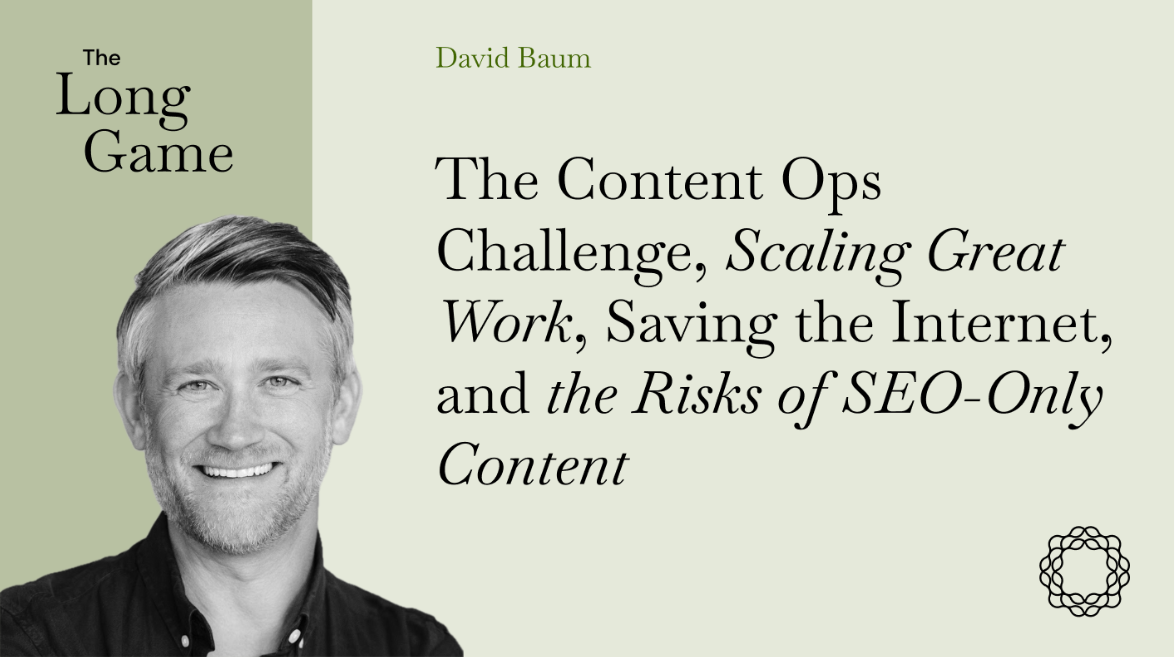

The content ops challenge is the gap between wanting to publish great work every week and having a system that lets you. Teams rarely stall for lack of ideas or talent. They stall because the operation underneath the work is a spreadsheet, a folder of docs, and a group chat, so every new writer, format, or campaign adds friction instead of output.
That is what Alex Birkett, co-founder of Omniscient Digital, and I spent an hour on for The Long Game podcast, in an episode called The Content Ops Challenge, Scaling Great Work, Saving the Internet, and the Risks of SEO-Only Content. It runs about 52 minutes. The chapter markers are below if you want to skip to a particular argument.
What the episode covers
The chapter markers below come from the episode page on Omniscient Digital, where you can also listen.
| Time | What we get into |
|---|---|
| 01:30 | Why content ops is a problem worth solving at all |
| 03:26 | The disarray in most content strategies |
| 06:15 | Defining content operations |
| 09:22 | What is wrong with the current approach |
| 13:43 | The gulf between content managers and writers |
| 19:02 | Centralization versus decentralization |
| 22:35 | What information and content are worth |
| 25:53 | The risk of an SEO-first approach |
| 33:40 | Saving the human internet |
| 45:20 | Cynicism and algorithmic delivery |
| 47:42 | Why discovering new content is still hard |
| 51:09 | The incentives for choosing the human route |
The content ops challenge, in plain terms
Content operations is the system of people, processes, and tools that turns a strategy into something that ships on a schedule. When that system is thin, growth costs you more than it gives you.
Alex and I kept circling back to the same observation: the work can be excellent and the operation can still be the thing that breaks. Teams build their own setup out of whatever is to hand, and the result is a stack that nobody designed and nobody owns. If you want the fuller version of the model, we laid it out in our content operations framework for B2B teams, which is the better starting point if you are here for definitions rather than the conversation.
Why content managers and writers see different problems
The segment at 13:43 is the one I would send to anyone building a team. Managers and writers sit at opposite ends of the same workflow and describe completely different jobs.
A content manager is measured on strategic goals across a whole program, so their problem is visibility. What is in flight, what is stuck, what shipped, and did any of it work. A writer, especially a freelancer, is holding several clients and several toolsets in their head at once, so their problem is context switching and briefs that arrive half-formed.
The trap is building a system that fixes one side by taxing the other. A manager gets a status dashboard and the writers pay for it in check-in messages. Writers get freedom and the manager pays for it in chasing. Getting this right starts with being honest about who owns what on a content team rather than assuming the roles are obvious.
Centralized or decentralized: where content ops should sit
At 19:02 we get into the structural question most growing programs eventually face. Neither answer is free.
Centralizing gives you consistency, one place to look, and one front door for requests. It also makes the central team a bottleneck the moment demand outpaces it. Decentralizing gives each team speed and ownership, and it produces duplicated work, inconsistent quality, and five different definitions of done.
What holds up in practice is splitting the question. Centralize the system of record and the standards, so there is one answer to “where is the current version” and one bar for what good looks like. Decentralize production, so the people closest to the subject can move. That split is only as good as the shared layer underneath it, which is why creating a single source of truth in content marketing is the piece worth getting right first.
Scaling content operations without flattening the work
Here is the trap on the volume side. The more content you produce, the easier it is to trade uniqueness for efficiency, to go from artisanal to assembly line. Content operations at scale is a quality problem wearing a volume costume.
There is no clean headcount threshold where this starts, and we have not measured one. The pattern we see is that the informal coordination that works fine with three people starts slipping once nobody can hold the whole board in their head any more.
The teams that grow without going generic tend to do three things. They protect a point of view instead of chasing every keyword. They give the operation a spine, so a fifth contributor does not mean a fifth way of doing things. And they keep one place where briefs, drafts, assets, and status live. For a deeper walk through the workflows that hold quality steady as output climbs, our guide on how to scale your content program without sacrificing quality covers the request-to-repurpose lifecycle in detail.
Why an SEO-only content strategy is the risky bet
The segment at 25:53 is the one that aged into the title of the episode. Search matters. The problem is what happens when it becomes the only reason a piece exists, which turns a whole content program into one concentrated bet.
Competition for the same terms has climbed, results pages move under you, and staying in the running takes real investment and publishing velocity. Chasing volume alone also pushes a team toward the safe, forgettable middle, where the piece could have been written by anyone and reads like it was. Two years on, the bet looks more concentrated than it did when we recorded, because Google now answers plenty of queries on the results page itself through AI Overviews, so a ranking and a visit have stopped being the same thing. Our SEO playbook covers what we do about that now, and tracking organic visibility in a zero-click world covers how to measure it when the traffic never arrives.
The related thread, which takes up the back third of the episode, is what happens to the internet when generative tools make forgettable content free to produce. Keeping the human element in the work is partly an ethical position and partly a competitive one. If a machine can produce your article, the article was never worth much.
What a content operations framework actually needs
A content operations framework is not a forty-page document nobody opens. The version that survives contact with a busy team fits on one page and names five things:
- Who owns the editorial calendar.
- Who owns distribution.
- How a brief becomes a draft.
- Where assets and statuses live.
- Which metrics get reviewed, and how often.
The first two lines are the ones teams fudge. Writing a team name where a person’s name belongs is how a framework quietly stops working, so it is worth defining content ownership properly before you commit the rest of the page to paper.
For B2B content operations, add the subject matter expert roster and the review cadence, since expert input and longer approval cycles are where B2B work usually gets stuck. Keep the framework short enough that everyone can hold it in their head, and revisit it each quarter as a living document. A standing quarterly content strategy check-in is where that revisit actually happens, rather than being something the team means to get to. If you are moving from a loose strategy to a running system, our piece on how to operationalize your content strategy shows how to turn the framework into a repeatable build.
Frequently asked questions about content operations
What is the content ops challenge?
It is the gap between wanting to publish great work every week and having a system that lets you. Teams rarely stall for lack of ideas or talent. They stall because the operation underneath the work is held together with spreadsheets, scattered docs, and a group chat.
What does content operations mean?
Content operations is the system of people, processes, and tools a team uses to plan, produce, publish, and measure content on a repeatable schedule. It is the connective tissue between a content strategy and the work that actually ships each week.
What does content operations at scale actually mean?
It means holding editorial quality steady while output, contributors, and formats all grow. The hard part is producing more without the work turning generic. There is no clean headcount threshold and we have not measured one. What we see is that coordination by conversation stops working once no one person can hold the whole board in their head.
Why do content managers and writers see different problems?
They sit at different ends of the same workflow. Managers are measured on outcomes across a whole program, so their problem is visibility. Writers are usually juggling several clients and toolsets, so their problem is context switching and unclear briefs. A system that only solves one side pushes the cost onto the other.
Should content operations be centralized or decentralized?
Both work and both fail in predictable ways. Centralizing buys consistency at the cost of becoming a bottleneck. Decentralizing buys speed at the cost of duplicated work and five definitions of done. Most teams centralize the system of record and the standards, then decentralize production.
Why is an SEO-only content strategy risky?
Competition for the same keywords has climbed, results pages move under you, and staying in the running takes real investment and velocity. Chasing search volume alone also pushes a team toward safe, forgettable pieces. Search is worth playing. Making it the only reason a piece exists is the part that carries risk.
What does a content operations framework include?
A working framework names five things on one page: who owns the calendar, who owns distribution, how briefs become drafts, where assets and statuses live, and which metrics get reviewed and how often. Keep it short, treat it as a living document, and revisit it every quarter.