AI content operations: where agents fit in the pre-publish workflow
AI content operations means assigning the repeatable stages of the pre-publish workflow to AI agents while a person keeps the angle and the final approval. Here is the human and agent division of labor, what changes and what does not, and the failure modes to watch.
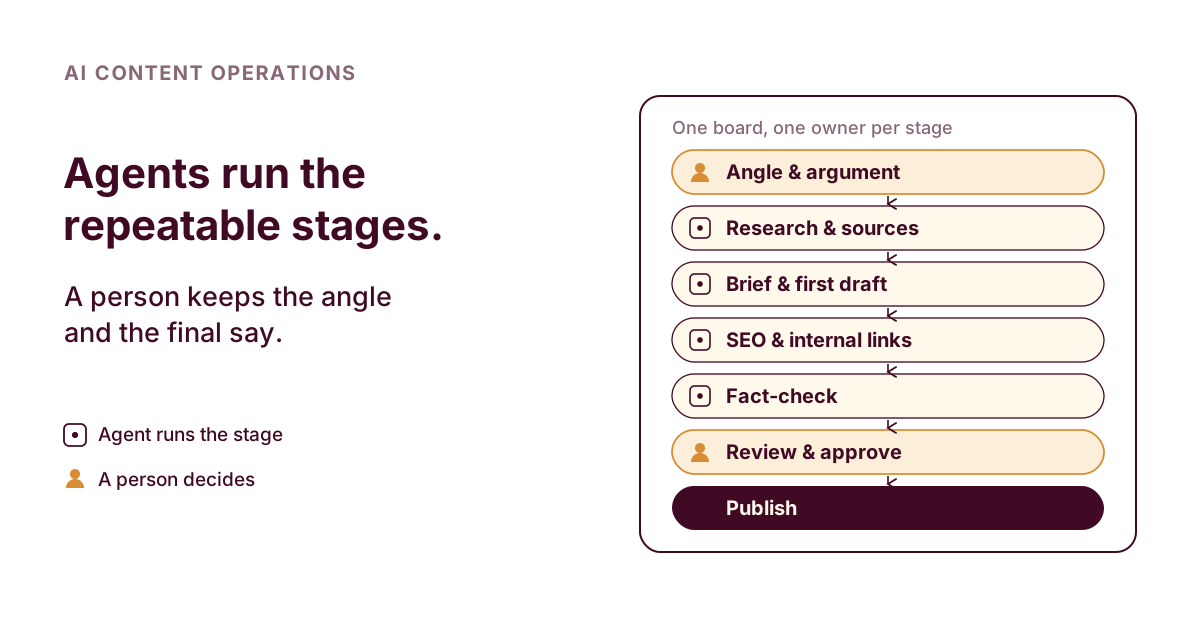

Hand the repeatable stages of content work to AI agents. Keep the judgment. That is AI content operations in one line: agents run the stages that repeat, and a person keeps the angle, the argument and the final approval.
The word that matters is inside. An agent assigned to a stage of your workflow can see the state of a piece and hand it on. A writing assistant in a separate tab cannot. Our explainer on what a content operations platform is draws that category boundary in full.
This piece is the operator-level version: which stages agents should run, what actually changes when you add them, and where AI creates new problems instead of solving old ones.
Which parts of content work should AI actually run?
The repeatable, checkable stages. Nothing else.
Repeatable and checkable means a human can verify the output in less time than the work would take by hand. That test produces a specific list:
- Research and source gathering. Pull the relevant studies, competitor coverage and internal pages, with links, so the writer starts from evidence rather than a blank page.
- SEO and on-page checks. Title, meta, heading structure, internal-link opportunities, schema. Mechanical rules an agent applies consistently and a person confirms at a glance.
- Internal-link suggestions. Surface the source sentence, the natural anchor and the target page, for a human to accept or reject.
- Fact-checking against sources. Flag any claim in a draft that the attached sources do not support, so the reviewer reads the flags instead of re-checking every line.
- Refresh scheduling. Watch for pages that have declined over a sustained window and queue a refresh brief before the page falls off the first result page.
Now look at what is missing: the angle, the argument, the point of view, the final yes. Those stay off the list for a reason. There is no correct answer to check a point of view against, and no agent can tell you whether a take will land with your particular reader. That is judgment. The review gate exists to protect it.
What stays a human job when agents do the rest?
The direction, and the final edit.
Ask what a machine can verify against a source, and what only a person can decide. An agent can confirm a claim matches its citation. It cannot decide which claim is interesting. Kevin Indig, growth advisor and author of the Growth Memo, put a name on where that leaves the people:
“We're all going to become more like directors of AI and conductors, or editors-in-chief.”

A director does not operate the camera. A conductor plays no instrument. The call about what the piece is for, and the edit that decides it is ready, stay with a person, while the agents carry the routine load between those two moments. Teams that get this backwards, letting agents pick the topics and approve their own output, publish content that reads assembled rather than written. Readers can tell.
What changes when you add AI to the ops layer, and what does not?
Speed changes. The workflow’s flaws do not.
The honest upside is narrow and real. When research, checks and briefs move from a person’s afternoon to an agent’s minutes, a piece travels from brief to review in a fraction of the time, and the writer spends the week on the parts only a writer can do. That is worth having. It is also the whole of it. A vendor promising more than throughput on the mechanical stages is selling something the category does not deliver.
The flaw that survives is the one teams miss. A review step that gets skipped under deadline is still skipped, just more often, because there is more to review. An angle nobody owns is still nobody’s, and agents fill that vacuum with competent, forgettable drafts.
So sequence it. Fix the workflow first: one owner per piece, and review as a gate that can actually stop things. Then hand the mechanical stages to agents. Done in the other order, you get more content and less control, the opposite of the trade you thought you were making.
Where does AI create new failure modes?
Three places, each with a specific fix: thin content, review load, and false confidence.
Thin content at scale. Drafting got cheap. Ahrefs put a number on it in a June 2025 study: about 131 dollars for an AI-generated blog post against 611 dollars for a human-written one, roughly 4.7 times cheaper. Cheap production tempts a team to publish more. More generic content is the fastest way to suppress a domain rather than grow it, and Ross Simmonds, founder of Foundation Marketing, was blunt about where the flood is heading:
“The amount of blog posts that are written with AI is at an all-time high… And all of it is trash.”

The fix is a hard publishing cap and a bar every piece must clear, enforced at the review gate. Cheaper drafting is a reason to ship less, chosen better.
Review load moves. It does not vanish. When agents draft faster, the bottleneck shifts from writing to checking. The person who wrote four pieces a week now reviews twelve, and the quality of that checking is all that stands between the team and the thin-content trap above. Resource the reviewer’s time as deliberately as the drafting, or the gate quietly stops holding.
False confidence. An agent states a plausible, specific, wrong thing in the same steady tone it uses for true things. A rushed reviewer waves it through. Nobody notices until a reader does. The containment is the fact-checking stage above, plus one rule at the gate: an agent’s factual claim stays unverified until a source is attached, no matter how finished the sentence sounds.
All three fixes are the same fix. AI in content operations is safe to the exact degree that a human review can still stop a piece. Remove the gate to go faster and you have removed the control the whole model depends on.
How we run Relato’s own content team with AI
We run our own content team on Relato. The division of labor above is how this blog gets made, day to day.
The repeatable stages belong to agents inside the board. Research gathers sources for a brief. One agent runs the SEO and internal-link checks and surfaces the exact anchor for a human to accept. Another watches for pages that have declined over a sustained window and queues a refresh. Each hands the piece on with its state attached, so nobody reconstructs status across a doc, a board and a chat thread.
The rule we hold hardest is the split between drafting and judging. The agent that drafts never grades its own work. A separate check scores the draft against our quality bar, and a named person approves before anything ships. An agent that writes and signs off its own output is the thin-content failure mode with the safety off. We would rather discard a weak draft than publish it. Most weeks we discard more than we keep.
We do not claim AI made our content team ten times anything. The change is smaller and more specific: the routine stages moved off people, review became the job that gets the attention, and the angle stayed a human decision. That is the trade the category actually offers. If your workflow already has one owner per piece and a review gate that holds, running the mechanical stages with agents inside that workflow is the next step. If it does not, fix that first, because AI amplifies whatever workflow it lands in. An unowned workflow, amplified, is noise produced faster.
References
- Kevin Indig, “Moving Beyond Old SEO Models in the Age of AI”, The Search Session interview, Advanced Web Ranking, January 19 2026. Quote on the human role as directors, conductors and editors-in-chief.
- Ross Simmonds, “Trash AI Content, Experimental Budgets, and TikTok for B2B: Ross Simmonds Unfiltered”, Marketing Against the Grain (HubSpot), September 1 2026. Quote on the volume of AI-written blog posts.
- Ryan Law, “AI Content Is 4.7x Cheaper Than Human Content”, Ahrefs, June 18 2025. Cost comparison of AI-generated versus human-written blog posts.